Outdoors Woman: Fishing With the Kiddos!


Fishing with my kids

Victoria, Olivia, Alexander and I enjoyed a trip to a local “kids only” fishing pond this week. Victoria’s friend, Sarah, was along for the outing.

Fishing with my kids is a favorite activity. I think back to only three years ago when they cast lines in the water for the first time in their lives. We had moved to Maine to pursue an outdoors lifestyle, and we set about immediately, outing by outing, exploring new experiences. It took us a while to jump into fishing, but from the first cast, all three kids were hooked!

Victoria fishing

Victoria has become quite the competitive and avid fisherman since she was first introduced to fishing.

I remember sharing with my best friend, Robin, that I’d been wanting to get the kids out and teach them to fish. Her husband, Steve, showed up one afternoon with three brand new fishing poles. The kids were ecstatic, and I think Uncle Steve enjoyed it, too. We started fishing just about every body of water we could, every chance we got.

It didn’t take long that summer for the back end of my van to look like a rolling campsite. Everywhere we went, the ice chest, camp chairs, fishing poles, tackle box and assorted gear and necessities were readily available when we opened the back door. I often picked the kids up after school, ran a few errands, then ended up on a bank or dock somewhere. Lines were in the water, and we were laughing and enjoying sunny days together.

bullfrog pollywog

Liv caught a bullfrog pollywog in the edge of the pond this week.

I learned right away while out fishing with three kids that as the only adult in the bunch, I didn’t have time to fish. In the beginning, I spent the majority of my time baiting hooks, untangling lines, unhooking lures from rocks and weeds, and taking fish off hooks. I had to get creative, at times, to keep the chaos in check with three kids, fishing lines and sharp little hooks flying everywhere.

I taught them that if they were going to fish, they were going to learn to bait a hook…keep their lines untangled…and clean fish. So they learned to be more self-sufficient, and I bought myself a new fishing pole. I enjoy fishing, too! As one, two then three trout came out of the water on our afternoon fishing trip this week, there was only one argument…who GETS to gut the fish. They each took care of their own, and I sat back, watched, smiled. I’m a very proud mother of capable outdoors kids.

Pumpkin Sunfish

Pumpkin Sunfish


Outdoors Woman, Meet Outdoors Man: Inside the Gos Nest (Part II)


We got home and settled after the exciting morning in the woods retrieving our eyas goshawk. We were both tired and sore from the long hike through wet, muddy trails. Dennis felt the burn from his tree climbing task, but there was still work to be done.
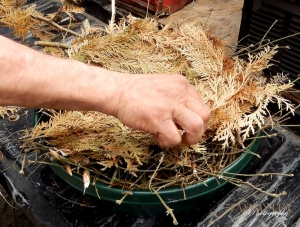
Building a goshawk nest

Building a goshawk nest

Our baby needed a new nest and had to be fed as regularly as a human infant. With no adult male and female goshawks present now to provide food and proper accommodations, guess who became Mom and Dad with the charge of caring for this new baby and meeting all its needs. Dennis cut branches and formed a nest base, then lined it with soft, brown cedar boughs. Our gos would be living in this nest for weeks, and our charge would include keeping the nest properly lined and free of left-over debree from feeding times. Poop in the nest…not an issue.

The dining table in the middle of our kitchen was lined with plastic, the nest bowl set in the middle, and he went to work building the “Poop Containment System” now fondly known by friends and family as the PCS. I’m REALLY thankful Dennis is such a smart and skilled craftsman. Yes, goshawks poop. A lot. Not neat and tidy style. They back their butts up to the edge of the nest and project poop across the room. FAR across the room, getting farther by the day the larger she gets. Yes, it’s gross, but it’s all part of the process and the commitment to “deal” when we chose to raise an eyas gos to hunt with.
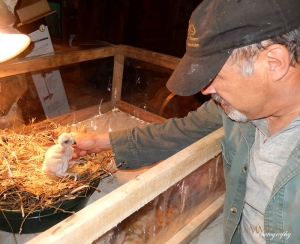
Dennis and the baby goshawk

Dennis and the eyas goshawk getting to know each other

The baby goshawk doesn’t eat grain or other plant based food. From the beginning, a hawk is a carnivore and requires numerous meals each day consisting of raw meat. Until they are old enough to learn to hunt and kill for themselves, it’s a chore for Mom and Dad. A typical goshawk diet consists of birds and mammals such as pigeon, quail, ruffed grouse, ducks, squirrels, chipmunks, hares and many other small to medium sized quarry. Food sources may be hunted during legal seasons, raised or purchased from a number of suppliers. Our freezer is being filled with a mass of red squirrels knocked out at our bird feeders, quail  and pigeons we raise for the hawk.

I was well versed in raising and butchering my own chickens and turkeys, but I still had to get through the learning curve involved in processing small game. The first day I cut into a squirrel while Dennis was at work and unable to show me the process, I had a few “Ewwwww” moments. I kept cutting. When your baby is hungry and looking up at you with those big, round eyes, you suck it up and do what you must.
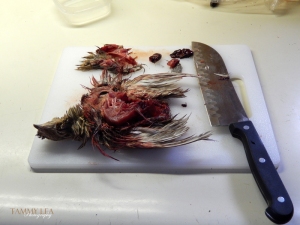
Processing a quail

Processing a quail to feed AIM-9

We are feeding off of wings and carcasses to familiarize the gos with what “food” looks like in the wild. It’s a crucial part of her training that she recognize food and not associate eating with human hands and fingers, so we are very cautious in our approach when we feed. She can’t be allowed to see us placing food in her nest, because we value our fingers and have to look ahead to when she’s full grown, nearly 1000 grams in weight and can rip a hand apart with her beak if it looks food-like to her. No, raising and training a raptor is not for the sloppy, careless or faint of heart.
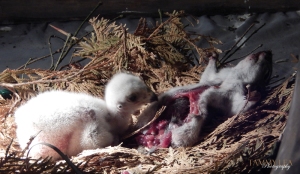
Feeding goshawk squirrel

Eyas Goshawk feeding off of a squirrel carcass

While raising a goshawk intended to hunt successfully in cooperation with a falconer, socialization is extremely important. We placed our nest area in the busiest, central location in our home. The eyas gos doesn’t need to be shielded from human contact or tucked away in a dark, quiet area. Our kids, grandkids and dog, Tori, all work and live around AIM-9 on a daily basis. She spends as much time as possible in the middle of our living room floor, surrounded by newspapers to catch the projectiles. 

(The AIM-9 Sidewinder is an infrared homing, short-range, air-to-air missile)

Liv and AIM-9

Liv and the Eyas Goshawk

We encourage the kids to pet her, handle her wings, tail and feet gently with only one cardinal rule – they cannot pick her up. It is an insult and sure-fire screaming match for the gos to be picked up and must be avoided as much as possible in her handling. She is being raised as naturally as feasible to become the stealth killing machine she was born to be. I’m so eager to see the amazing creature she grows into in the weeks and months ahead!

I have shared in previous articles the reasoning behind choosing a female goshawk as opposed to a male for better hunting capabilities. After an unsuccessful attempt to train and hunt with a tiercel, Dennis was adamant in choosing a female eyas this year. We chose to go the route of sending off DNA samples to a biotech lab for accurate sexing so there was no guess-work involved. We waited impatiently between Saturday and Tuesday afternoon…very impatiently! I checked, re-checked and checked again for the results to be posted online. We kept thinking and talking about that one little baby gos we left behind in the nest, surrounded by the wild and so many predators. What if…

What if the eyas we brought home was male? What if the little nestling turned out to be the female and we went back to find her gone, the nest empty. What if Jimmy G went home with the only female and our baby AND the nestling were both male? What would be our Plan B? Would we return a tiercel to the nest and just try again next year or would we attempt another training with a male? In dealing with nature, anything is possible and nothing at all is predictable.

Around 5pm, just before going outside to watch the girls work with the horses, I took one more look at our account online at Avian Biotech. There it was! OMG, THERE IT WAS!

Dennis: Male

Jimmy: Male

Nestling: Female

I could hardly breathe on my way down to the pasture to tell Dennis the news. There WAS a female in that clutch, and she was still 35 feet up that Ash tree in the nest that I only hoped was still intact and safe for her. I told Dennis with tears in my eyes, and he immediately flew into action. It was nearing dark, but we weren’t wasting another day getting back to that tree. We loaded the climbing gear and the tiercel male we’d been caring for and headed to the woods. We KNEW it. We just had a feeling that was going to be the case after the visual IDs left us all thinking the chicks we took were probably male.

Of course, this nest was down the longest, most difficult hiking trail in our  inventory of nest sites. It was a long, hard walk that was reallllly slow going for me. I told Dennis to go ahead. I’d catch up. He needed to gear up and could be ahead of me and ready as soon as I reached the tree. I mushed on behind him, quickly losing sight of him as I battled thick masses of mosquitoes and even thicker, deeper mud. My Mucks sunk up so deeply I had to wiggle and pull my feet out of the ground at times. I don’t think any of the times past that we’ve walked that particular trail took half as long as it seemed to take that day, knowing (hoping) our little huntress was waiting at the end of the walk.

I finally reached him, all ready to climb, ropes around the tree holding him securely. He headed up. The female goshawk was circling and kakking at him before his feet left the ground. That was a great sign! I was able to photograph her for the first time that day. She’s been super stealth all other times we’ve heard and caught glimpses of her. That day she wasn’t screwing around!
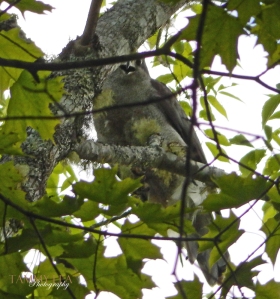
Female goshawk defending nest

AIM-9’s Mama is a smart, fierce, absolutely gorgeous goshawk!

He reached the nest to find the baby there, our little female eyas goshawk! He was securing himself to the tree to begin the swapping of babies, Mama Gos circling and screaming at him. We both heard her coming in, and I was trying to get my eyes and camera on her when suddenly, there she was!

Dennis had just turned to see her coming at him in time to get hit, head on. She hit him with such force that he saw stars, and I heard the thud. I couldn’t get my camera up fast enough, but breathed a sigh of relief that he was still securely attached to the tree. If he had been untied during that impact, I’m certain she’d have knocked him out of the tree. So there it was! He’d been hoping for some battle scars to take away from this experience, worn as badges of honor. Boy, did he get rewarded that day!
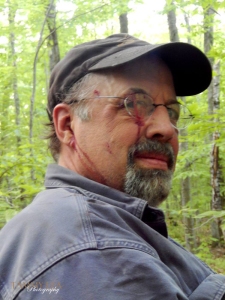
goshawk attack

Dennis after goshawk attack while retrieving our female eyas gos

We brought home a prized female goshawk. She came to us through blood, sweat, tears and miles upon miles of hiking, hunting and priceless time spent together in the woods. I’m settling well into the task and joy of raising a special hunting partner with this outdoorsman of mine leading the endeavor and training me and her both as we go along. She is already growing and learning incredibly fast! What an adventure!
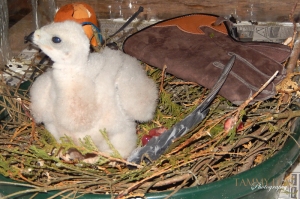
AIM-9 at 16 days

AIM-9 at 16 days

Till next time…

Outdoors Woman, Meet Outdoors Man: Inside the Gos Nest (Part I)


We started our hunt in March. Snow was up to our thighs in many places deep in the Maine woods. Brooks and streams were still frozen, and we were walking with snowshoes and sometimes without on top of hard crust. At times, we broke through and buried up to our asses. We were bundled up to our eyeballs and sitting against trees on zero degree mornings before daylight, listening for those unique courtship vocalizations. We logged no telling how many miles of hiking in our search for goshawk territories. We discovered 15 nests and concluded that we had three active pairs. We knew, regardless of our successful finds, that we may come up empty-handed when it became time to retrieve a female eyas gos. We still hunted.

Goshawk nest hunting

Goshawk nest hunting in April just before sunset

Dennis and I sat in our usual seats eating desserts at the counter at Grammy’s Country Inn as a wicked storm cell blew through that Friday night. We heard the wind roaring and rain beating down. Fallen apple blossoms were swirling in the air. We watched through the window, looked at each other and shook our heads. We were concerned about our baby gos filled nests being damaged before we could get back to them the next morning to bring our eyas home. I felt like an expectant mother who had just run into complications, and it was nerve-wracking. It turned into a long night of restless sleep and a phone call at 3:30 in the morning to get us up and running.

We were joined by a couple of Dennis’s falconer friends for this excursion. Jimmy G came up with hopes of acquiring his own eyas goshawk if our nests proved reliable. Mark taught biology at Bonny Eagle High School in Standish, Maine and has become quite the expert on these birds of prey. He has proven highly reliable in distinguishing the males from females in their earliest stages. I was looking forward to watching these guys in action and learning all I could. Also along on this trip were good friends of Jimmy. Sean, who works as an arborist, came to climb one of the two trees, and Kyle wanted to come along for the ride to check out this falconry thing. Before they left, he’d been well indoctrinated and sounded like he’d been bitten by the bug. I could totally relate!

Dennis climbing to check goshawk nest

Dennis gearing up to climb up to the first nest while I checked out the claw marks left by a predator that had tried to get past the tin barrier we’d placed to help protect the nest.

We hiked to our first nest site just after sunrise on this warm and humid June morning. The mosquitoes were relentless, making their way through multiple layers of bug spray. The ground was wet and slippery, our jeans quickly soaked through. We were all so excited and hopeful of going home with the coveted babies that inconveniences and discomforts were easily overlooked. Our eyes were on the prize!

We got to the yellow birch that housed our first nest, and Dennis got his gear together, put on spikes and ropes and started the 45 foot climb. He secretly hoped the female would hit him, and he’d get a nice badge of honor (scar) to sport after this adventure. Ok, maybe it was no secret wish. I think he told everyone he talked to leading up to the big day. I secretly (or not) hoped he’d get through this day without a scratch.

I checked out the tin we’d placed on a previous visit to help secure the nest, and it became clear to me why we take that extra step. There were claw marks in several places on the tin where a predator had attempted to climb the tree. We hoped it hadn’t made it past the barrier. We’d know soon.

575405_10200983340361490_1453694779_n

Dennis climbed the slippery yellow birch to see what was in Nest #1

We watched anxiously, our necks bending further and further back the higher Dennis got. He has no fear of heights. I actually think he has no fear of anything! Me…terribly afraid of heights. I was antsy watching him climb the wet, birch with its slippery peeling bark. He slipped and slid part of the way down the tree once, taking my breath away. I don’t think I breathed again until his feet were back on the ground.

Watching Dennis climb

Jimmy G watching patiently…or impatiently!

We waited until he reached the nest. The mama goshawk soared, circled and kakked away at him, but she never went near him. I watched her closely. We were silent, expecting his announcement any moment now. He said quietly, “Shit.” The nest had only one baby gos, roughly 12 days old at best guess. After looking it over for a few minutes, Dennis decided it was most likely a tiercel (male). It was not what we were looking for, but being the only eyas in the nest, we weren’t allowed to remove it anyway. Disappointment was felt in the air and on the ground. He began the climb down as we prepared to move on to the next – and last – active nest site.

Sean preparing to climb to the gos nest

Sean prepares to climb to the second nest.

This was our last chance to acquire an eyas gos this season, so we were all anxious about what we’d find up that tree. Sean geared up to climb, Dennis prepped the basket to lower babies down from the nest, and the rest of us scoped out the area while watching and listening for the mama. We checked out the tin on this tree and determined that a bear was the culprit for the damage found there. It left a paw print behind! A bear wouldn’t have been after the babies but may have simply been curious to check out the funny looking Ash tree with a black band.

Bear climbed

A bear tried to climb the tree, pulled the tin down a couple of inches and bent it up. Mark takes a good look at it.

bear paw print

Bear paw print

Sean was up the tree before we knew it. We waited for the word. Two babies. Three babies! We put a couple of our cameras in the transport box and he pulled it up by its rope to get a few shots of the hawks in their nest before lowering the babies down for inspection to determine the sexes. Not many people will ever be lucky enough to see an eyas gos in person, much less have a bird’s eye view of their nest. How cool!

Three eyas goshawks in nest

Three eyas goshawks in their nest near the top of an Ash tree

Sean lowered the nestlings down and Dennis, Mark and Jim went to work immediately looking them over. At such a young age, sexing these birds is a challenging task. It takes a lot of experience looking at a variety of them to get a feel for spotting the extremely subtle differences between males and females. After the best guess, it’s still an absolute crap shoot without DNA testing. We had already decided that’s what we’d do, no matter how certain we may be of what we were looking at.

determining goshawk sex

Inspecting the nestlings to determine sex

The guys decided we were looking at two of the same sex in the first hatchlings, which were a good bit larger than the little bitty one. Judging by the shape of their heads, beaks and the length of feathering down the tarsi, it was decided they were likely tiercels. The little one was nearly impossible to sex due to the small size. That nestling was only a day old.

They clipped a talon on each eyas to collect a few drops of blood. We decided to take the two larger birds so we’d have an imprint to work with (male or female) in case something happened to the nest before the DNA results were in. We may just be stuck with a male unless we opted to return it to the nest based on the test results. Dennis and Jim would make that decision when the time came.

Collecting goshawk DNA samples

DNA samples were collected from the three baby goshawks.

Sean repelled out of the Ash, we secured our gos babies in the carrier so they’d be safe and warm, and we headed out of the woods.

Sean repelling from Ash

Sean repels out of the Ash tree.

We had to get home, get the babies set up and finish the paperwork for the DNA testing. We wanted to get to the post office before it closed so we could expedite shipping. That done, our very happy group of adventurers headed to Grammy’s for lunch. Job well done through some awesome teamwork! Now the hard part…waiting.

Proud goshawk mama

Proud goshawk mama

The guys escaped attack from both female goshawks that day, but Dennis didn’t fare so well on our trip out a few days later. Check back next week for the DNA results and to hear the rest of the story when I tell you about my greatest outing of all time with this outdoorsman of mine!

Dennis after goshawk attack

Till next time…